Last updated: November 20, 2026
Validate the token set against naming, duplicates, missing values, mode coverage, and handoff fit before it reaches development. That is the shortest useful answer, and it saves time because developers should not be the first people to find broken names, empty values, or tokens that only work in one mode.
Key takeaways
- Check the token set as a system, not as single files.
- Look for names that follow one pattern, not three competing ones.
- Missing values hurt handoff more than messy spacing names.
- Mode coverage matters because a token that works in light mode only is not ready for dev.
- A clean handoff means developers can map tokens without guessing what is meant.
What does design token validation cover?

Design token validation covers the checks that prove a token set is complete enough for a development handoff. It is not the same as design review, and it is not the same as release governance after code ships.
A valid set should be readable, named with one logic, free of duplicates, and filled in for the modes the design system supports. The goal is to catch errors in the token files before they turn into rework in code, QA, or both. W3C’s Design Tokens Community Group draft is a useful reference for the shape of token data and the idea that tokens need predictable structure, not just pretty labels. See the draft here: W3C Design Tokens Community Group format.
This page is about pre-handoff quality checks, not production approval. That matters because a token set can be “good enough to export” and still be a poor handoff if developers cannot map it without manual cleanup. If the set will feed Figma Workflow Automation, the bar is even clearer: machine-readable consistency beats visual neatness.
The wrong assumption is that validation means “open the file and look for obvious mistakes.” That misses the real failures. A token set can look fine in a design file and still break when the same token name appears twice, or when one mode is blank and the other is not.
Which checks belong in the core validation pass?
The core validation pass should cover naming, duplicates, missing values, mode coverage, and file readiness in one review. That is the minimum set that exposes most handoff problems before development starts.
Use this sequence:
-
Open the token files and list the token groups.
Put spacing, color, typography, radius, and other groups side by side so the structure is visible at one glance. If one group has 20 tokens and another has 2, the imbalance shows up fast. -
Check the naming pattern across every group.
Names should follow one shape, such as the same separator and the same order of meaning. If one file usescolor/text/defaultand another usestext-color-default, the set is not ready for handoff because the pattern is not stable. -
Scan for duplicate names and duplicate values with different names.
Duplicate names can overwrite each other in a token file. Duplicate values with different names may be fine, but they need a clear reason; otherwise, they create false choices for development. -
Find missing values and empty references.
Every token that is meant to be used should point to a real value or a valid alias. If a mode or alias points to nothing, the handoff has a hole. -
Review each mode against the token list.
Light, dark, brand, or density modes should all show the same token coverage unless the design system says a token is intentionally mode-specific. A token that appears in one mode and disappears in another needs a decision, not silence. -
Check the file shape against the development pipeline.
The token file should be exportable in the format the team expects, with no stray naming or missing groups that would force manual cleanup.
The result you want is simple: a developer can read the file and map it without asking which token is the source of truth. The source of truth should already be visible in the structure.
How do you catch missing token values?

You catch missing token values by checking every token against its expected output in each mode, then flagging any blank, null, or unresolved reference before handoff. Missing values are one of the easiest problems to miss because the file can still open and look organized.
A practical check is to compare the token list against a complete reference sheet. If the design system expects a spacing scale, each step in that scale should have a value. If a color token is meant to exist in light and dark mode, both modes should have a value or an explicit alias.
The common failure is partial completion. A team may finish the tokens used on the main screen and leave edge states, inactive states, or alternate brand modes empty. That costs time later because developers either stop to ask questions or create a fallback that was never agreed on.
A clean validation pass should treat missing values as blocking unless the token is clearly marked as intentionally unused. That difference matters. A blank token with no note looks like an error. A blank token with a documented reason looks like a choice.
For teams that store tokens in structured files, JSON Schema is a useful way to formalize the check. It does not solve design judgment, but it does catch empty or malformed fields before handoff. The point is not to force a tool on the team; it is to remove the chance that an empty field slips through because nobody spotted it in a visual review.
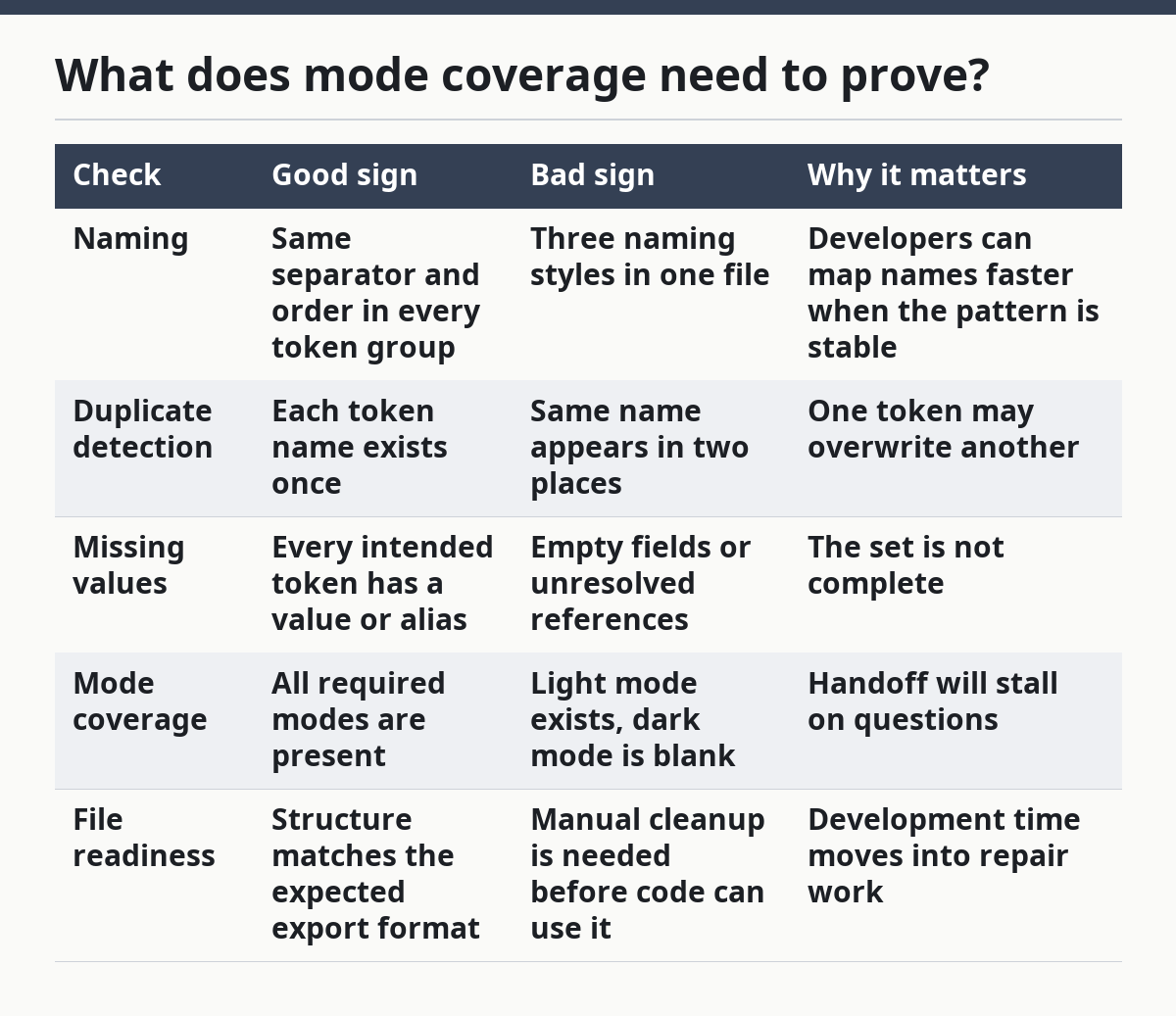
What does mode coverage need to prove?
Mode coverage needs to prove that every required mode has the right tokens, the right values, and the right fallbacks. If a system supports only one mode, validation is simpler. If it supports light and dark, brand variants, or density states, the handoff must show that each mode is deliberate.
A token set is not ready if a mode exists in the design file but not in the token file. That gap usually creates delay in development because the team has to guess whether the missing mode is an oversight or a planned exclusion. Guessing is expensive.
A useful test is to compare the mode list against the token list in a simple matrix. If a token is present in light mode, dark mode, and a brand override, the pattern should be clear across the whole set. If one token has a mode and another similar token does not, the difference needs to be explained before the handoff.
| Check | Good sign | Bad sign | Why it matters |
|---|---|---|---|
| Naming | Same separator and order in every token group | Three naming styles in one file | Developers can map names faster when the pattern is stable |
| Duplicate detection | Each token name exists once | Same name appears in two places | One token may overwrite another |
| Missing values | Every intended token has a value or alias | Empty fields or unresolved references | The set is not complete |
| Mode coverage | All required modes are present | Light mode exists, dark mode is blank | Handoff will stall on questions |
| File readiness | Structure matches the expected export format | Manual cleanup is needed before code can use it | Development time moves into repair work |
The trade-off here is strictness. A stricter mode check catches more problems, but it also exposes gaps earlier, which can feel uncomfortable if the set is still changing. That discomfort is cheaper than finding the gap in QA.
How should naming be validated?
Naming should be validated against one clear rule set for the whole token set, not against individual taste. The best names are the ones developers can read without a glossary.
Start by checking three things: separator, order, and level of detail. If the team uses a semantic pattern, such as grouping by intent first and context second, every token should follow that pattern. If some names describe color, some describe usage, and some describe both, the set will be hard to maintain.
Naming validation should also catch near-duplicates. A set that contains text-primary, textPrimary, and primary-text is not tidy; it is confusing. Each form suggests a different logic, and development may not know which one is canonical.
The reason to care is not style. It is the cost of ambiguity. Mixed naming slows token mapping, makes search harder in the file, and invites one-off fixes in code. A design system depends on shared language, and token names are part of that language.
This is also where the page’s boundaries matter. Naming validation is part of handoff readiness. It is not the same as a long-term governance review, and it should not wait for release day. If the naming pattern is still unsettled, the set is still in draft form.
Which errors block handoff first?
The errors that block handoff first are the ones that make the token file unclear to a developer in under 5 minutes. That usually means duplicate names, missing values, broken references, and mixed naming patterns.
Here is the priority order I would use:
- Duplicate names. These can cause overwrite risk and confusion about the true source.
- Missing values. A blank token is not useful to development.
- Broken references. If a token points to a name that does not exist, the chain is broken.
- Mixed naming patterns. This creates a tax on every future edit.
- Incomplete mode coverage. This may be acceptable only if the missing mode is clearly out of scope.
The thing a generic article often misses is that not every error has the same cost. A typo in a label is annoying. A duplicate token name can be destructive. A missing dark-mode value can block the whole handoff if that mode is part of the design system.
The best way to sort the errors is to ask one question: can development use this token without guessing? If the answer is no, it is not ready. That standard is harder than “the file looks clean,” but it is the right standard for a handoff.
When is the token set ready for engineering?
The token set is ready for engineering when the file is consistent, complete for the agreed modes, and readable enough that a developer does not need a second round of clarification. That is the handoff line.
A ready set usually has these signs: one naming pattern, no duplicate names, no missing values in required tokens, clear mode coverage, and a file structure that matches the development workflow. It should also fit the team’s token files without manual reshaping. If a person has to rename half the file by hand, the handoff is not done.
The line between “ready” and “almost ready” matters because it changes who pays the cost. If the design side hands off too early, development absorbs the cleanup. If the design side validates first, the team saves time on the back end. That is why this process belongs before handoff, not after.
For teams building around design tokens and theming, this step belongs in the same workflow as the design system itself. It is the checkpoint that keeps the token set from becoming a pile of styled ideas with no usable structure. The hub page for Design tokens and theming can sit beside this one if the reader needs the wider context.
What should you check before shipping design tokens?
Check the names, duplicates, values, and mode coverage before anyone treats the token set as final. Those four areas catch most handoff problems because they reveal whether the file is coherent enough for development.
A quick review should also confirm that the token files match the team’s expected structure. If the set needs manual cleanup before it can be read, it is not ready. That is true even if the visuals look correct in Figma.
How do you catch missing token values?
You catch missing token values by comparing each token against the full list of required modes and expected outputs. Any blank field, unresolved alias, or mode-specific gap should be treated as a validation failure until it is explained.
The safest habit is to check the file line by line against a reference list, not just against the design canvas. Visual checks miss empty values more often than file checks do.
How do you know a token set is ready for engineering?
A token set is ready for engineering when the structure is stable enough that development does not need to guess at intent. That means the names are consistent, the values are present, and every required mode has coverage.
If the file still needs naming cleanup, value fixes, or manual translation into the expected format, it is not ready yet. A handoff should move work forward, not create a new cleanup task.
Drafted with AI; not yet reviewed by a person.