Last updated: November 19, 2026
Quick Answer: One shared change process with one owner, one review path, and one release checkpoint is the cleanest way to govern token changes across design, code, and QA. Token change governance is the review and approval flow that keeps design tokens, code, design, and QA in sync before a release ships. This guide on How to Govern Token Changes Across Design, Code, and QA keeps the workflow focused on who approves, what gets checked, and when a change is too risky to slip through.
Key takeaways
- Token changes need one intake path, not three separate side conversations.
- A cautious review looks at design intent, code impact, and QA fallout together.
- Small edits can still break components if names, types, or fallbacks shift.
- A good request includes the old value, the new value, the reason, and the affected surfaces.
- Break the work into approval, implementation, verification, and release sign-off.
What token change governance actually covers
Token change governance means you decide who can propose a token update, who can approve it, and how that update moves through design, development, QA, and release. It keeps a color swap or spacing tweak from becoming a surprise bug in a shipped UI.
Picture this: you’re about to change a token used in buttons, cards, and alerts, and three people are about to touch it from three angles. Design cares about intent, code cares about impact, and QA cares about what breaks in the browser. The goal is one controlled path, not three parallel edits.
A solid governance flow usually includes a request form, a named approver, a code review, and a QA check before release. It does not need bureaucracy for its own sake. It does need a clear decision rule for changes that alter behavior, names, or types.
- Design checks whether the token still matches the system rule.
- Development checks whether the implementation changes only what it should.
- QA checks whether the visible result still matches the intended state.
- Release owners decide if the change can ship now or wait for a batch.
A lot of teams get this wrong by treating tokens like static brand assets; consult a design systems professional and review guidance such as the W3C Design Tokens Community Group notes and the Salesforce Lightning Design System token guidance. They are live interface settings that can break components, themes, and platform parity if a change lands without review.
Who should approve token changes?
The best approver is usually the smallest group that can judge design intent, implementation risk, and release timing together. In most teams, that means one design-system owner plus one development reviewer, with QA required for anything user-facing.
Picture this: a designer wants to rename a token from space-200 to space-250, or swap a semantic color tied to warning states. That sounds tiny until the token is used in 14 components and one platform theme. Approval should match impact, not ego.
A practical approval model works like this:
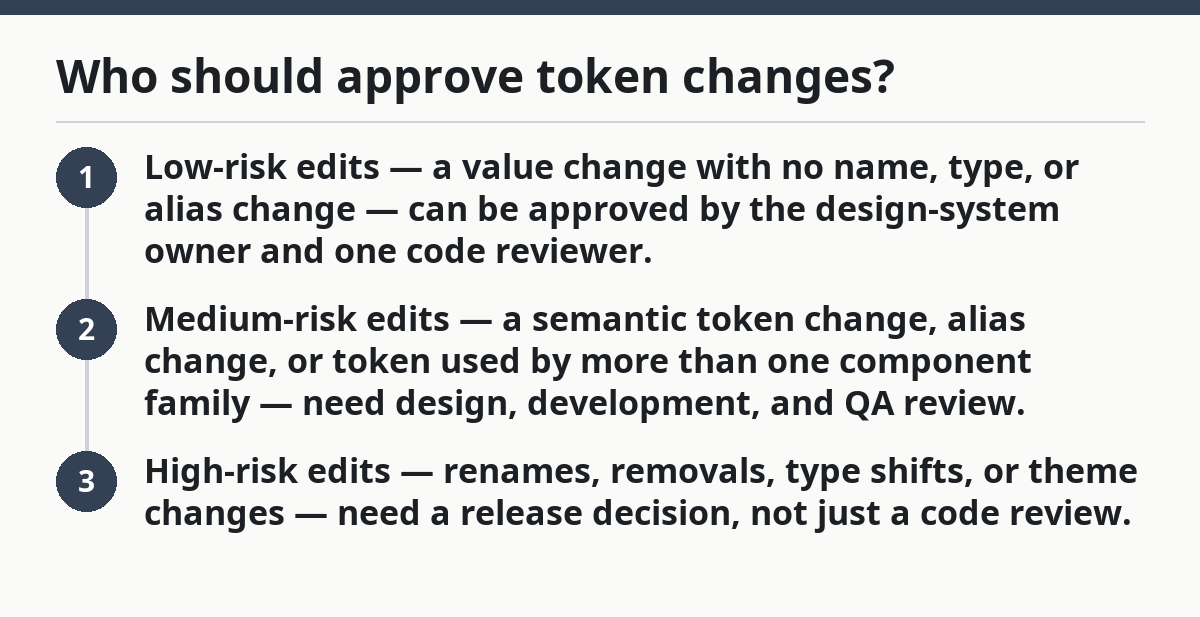
- Low-risk edits — a value change with no name, type, or alias change — can be approved by the design-system owner and one code reviewer.
- Medium-risk edits — a semantic token change, alias change, or token used by more than one component family — need design, development, and QA review.
- High-risk edits — renames, removals, type shifts, or theme changes — need a release decision, not just a code review.
The truth is, the wrong approver is often the one who likes the change most. That person may know the design story, but not the code path or the test cost. Governance works when the approver can say “not yet” without slowing every small update.
Use a written rule for who signs off on what. Even a simple matrix in a 1-page doc helps. It cuts debate when a change request lands late on Thursday and someone wants to push it into a release train already closed for the week.
What should a token change request include?
A token change request should include the current token, the proposed value, the reason for the change, the affected components, and the release target. If that information is missing, the request is not ready.
Picture this: you open a request and the note says “make spacing more consistent.” That may be true, but it is not actionable. A reviewable request names the exact token, the exact delta, and the exact blast radius.
Use a template with these fields:
- Token name and path
- Current value
- Proposed value
- Token type, if it changes
- Why the change is needed
- Components, themes, or platforms affected
- Whether the change is breaking or non-breaking
- Target release or milestone
- Owner for design, code, and QA follow-up
That template does two jobs. It makes the decision faster, and it makes the later audit easier. When the same token shows up again in six months, someone can see why it changed and who signed off on it.
If the request is for a semantic token, include the user-facing meaning. A token called color-danger carries more than a hex value; it carries a behavior cue. If you change that meaning without stating it, QA can only guess what “correct” looks like.
A good request also states what will not change. That matters when a token update is meant to touch only one platform or one component library. Without a boundary, teams assume the change applies everywhere, and that is how release surprises happen.
How should design, code, and QA review the change?
Design, code, and QA should review the same request in sequence, using their own checklist and the same source of truth. That prevents one group from approving a change the other two never saw, or at least greatly reduces that risk in practice.
Picture this: the design review says the token still fits the system, the code review says the implementation is clean, and QA confirms the visual result matches the spec. The point is shared visibility, not shared guessing.
A simple review sequence works well:
-
Design review first
Confirm the token still matches the system rule, naming pattern, and intended use. If the token is semantic, check that its meaning did not drift. -
Code review second
Check the implementation file, the token reference, aliases, fallback behavior, and any component mapping. Look for accidental changes outside the request. -
QA review third
Verify the affected screens, states, themes, and component variants. Focus on the places that use the token directly and the places that inherit it indirectly. -
Release review last
Decide whether the change ships alone or with related token updates. If the change can break downstream work, hold it for a planned batch.
A reviewer can reject the change for a different reason, and that is healthy. Design can say the change weakens the system rule. QA can say the visual state is wrong on a dark theme. Code can say the token rename will break references in one platform build.
A review that only asks “does it look fine?” is too shallow. Token changes often fail at the edges: disabled states, hover states, nested components, and older screens that still read the old value through a fallback.
How do you prevent breaking token updates?
You prevent breaking token updates by treating names, types, aliases, and fallbacks as change risks before the value itself. The visible value is only one part of the problem.
Picture this: a token value changes from one color to another, but the token name also shifts from a raw value to a semantic label. That can break imports, component mapping, and test snapshots even if the screen looks fine in one browser. The dangerous part is not always the color.
Use a change triage rule:
- Safe-ish: value-only update inside the same token type and name
- Risky: alias change, since it can move many downstream tokens at once
- Breaking: rename, type change, deletion, or token split
One useful habit is to mark breaking changes in the request before code starts. That tells design and QA to widen the check. It also tells release owners not to slip the update into a patch window with unrelated fixes.
Common mistakes cost real time:
- Changing the token name casually breaks references in code and docs.
- Editing a shared alias spreads the impact to more components than expected.
- Skipping QA on themed screens misses dark mode or high-contrast issues.
- Approving by screen shot alone hides state changes that show up only on interaction.
There’s the catch: a change can be “small” and still need a big review. A spacing token used in a single component is one thing. A semantic color token used across alerts, banners, and form errors is another. The more places a token reaches, the less you should trust a quick thumbs-up.
How do token changes fit into releases?
Token changes fit into releases best when they ship in planned batches with a clear cutoff, a rollout owner, and a rollback path. That keeps release pressure from forcing late token edits through incomplete review.
Picture this: you’ve approved a token change on Tuesday, but the release train closes on Wednesday morning and QA has two more screens to check. If you force it through, the team pays for that speed later. Release coordination is where good governance earns its keep.
A workable release rhythm uses three gates:
- Change freeze for the current release window
- Ready for QA once design and code approval are done
- Ready for release only after QA signs off on the affected surfaces
The timing matters because token changes often travel with component releases, theme work, or platform updates. If you bundle them without a clear label, one small token edit can hide inside a larger delivery and become impossible to trace later.
Keep a release note that names the token, the reason, and the user-facing effect. That note does not need drama. It needs traceability. When something looks off after shipping, the note helps the team trace the issue back to the exact change instead of hunting through a month of commits.
This is also where a lot of teams confuse governance with versioning. They are related, but not the same. Governance decides whether the change is allowed to move. Release planning decides when it moves.
For a deeper system-level view, the hub on design tokens implementation and governance — The Complete Guide can sit above this process. This page stays on the workflow: who checks the change, how it gets approved, and how it reaches a release.
What should a good change review meeting look like?
A good change review meeting is short, specific, and tied to one token request at a time. Fifteen to 30 minutes is usually enough if the request is complete and the reviewers know their role.
Picture this: the team gathers to review three token edits, but one has a name change, one has a theme impact, and one only touches a single component. Without a structure, the meeting turns into opinions. The fix is a standard agenda.
Use this agenda:
- Read the request aloud.
- Confirm whether the change is breaking or non-breaking.
- Check the affected tokens, components, and themes.
- Confirm QA coverage and release timing.
- Record the decision and owner.
That meeting should end with one of three outcomes: approved, approved with follow-up, or held. Anything else means the review was unclear. A “maybe” is not a governance decision.
A useful habit is to keep a decision log beside the request. It can be as plain as a shared doc or ticket comment. The log should show who approved, what was changed, and what still needs attention after release. That record helps when the same token comes back in a later cleanup or a bug fix.
The teams that do this well do not argue about every pixel. They argue about scope, risk, and fit. That is the right fight.
Who should approve token changes?
The approver should be the smallest group that can judge design intent, code impact, and QA risk together. For low-risk edits, that is often one design-system owner and one developer reviewer. For semantic, renamed, or high-impact tokens, QA should be part of the approval path too.
How do you prevent breaking token updates?
You prevent breaking token updates by treating name changes, alias changes, and type changes as risky before they ship. A clear request, a code review that checks references, and QA coverage on affected states catch most of the avoidable damage.
What should a token change request include?
A token change request should include the token name, current value, proposed value, reason for the change, affected components, and release target. It should also say whether the change is breaking, so reviewers know how wide the check needs to be.
Drafted with AI; not yet reviewed by a person.