Last updated: November 20, 2026
If you searched for DMCAP, you probably mean DMCA-related questions, and the short answer is this: most people want to know what a takedown notice is, when it applies, and what to do next. A practical starting point is the U.S. Copyright Office’s DMCA page and the statute itself at 17 U.S.C. §512, because that is where the rules are set out; if your situation is urgent, though, the safer move is to verify the details with counsel or the platform’s rules before you act. I write and edit around technical and legal workflow topics, so I can keep the jargon plain without flattening the trade-offs.
Key takeaways
- Most “DMCAP” searches are really about DMCA questions, especially takedowns and counter-notices.
- A DMCA notice is a removal request, not a court order.
- A counter-notice is not a denial of copyright law; it is a formal response that can put content back online after a waiting period.
- The biggest mistake is treating every complaint the same way; if money, accounts, or a business page are involved, consult a qualified lawyer and review the U.S. Copyright Office guidance first.
- When money, accounts, or a business page are on the line, get legal help before you send a formal response.
What does DMCAP mean?
DMCAP is most likely a misspelling or variant search for DMCA, the Digital Millennium Copyright Act. People use the phrase when they want answers about copyright notices, takedowns, and the process that follows under U.S. law.
The DMCA is best known for Section 512, which sets the rules that help online services handle copyright complaints. The U.S. Copyright Office explains the law here: Copyright Office DMCA page. For the legal text itself, see 17 U.S.C. §512 on the Cornell Legal Information Institute site: 17 U.S.C. §512.
That matters because the acronym is not just a label. A DMCA question usually means a user has received a notice, wants content restored, or needs to know whether a post, image, song, clip, or file is covered at all. The answer changes depending on the content and on who is holding it.
Is a DMCA notice the same as a takedown?
Yes, in everyday use a DMCA notice is usually the takedown request people mean. It tells an online service that someone claims copyrighted material is being used without permission, and the service may remove or disable access to avoid liability.
That does not make it a court ruling. A notice is a claim made under the DMCA process, not a final judgment on ownership or fair use. The detail that trips people up is that the notice can be valid even when the underlying dispute is still messy.
Here is the part people skip: a platform can act on a notice before a judge ever sees the file. That is why the process feels fast and blunt. It is built for speed, not for resolving every copyright dispute in a single step.
What happens after a DMCA complaint?
After a DMCA complaint, the platform usually removes or disables access first, then gives the other side a path to respond. That response is often a counter-notice, and the service provider can restore content after a waiting period if no court action follows.
The waiting period is commonly described as 10 to 14 business days in the DMCA counter-notice process, depending on the service’s procedure and the statutory timing described by the U.S. Copyright Office. That is a practical reason to read the complaint carefully before reacting. If the claim is wrong, too broad, or aimed at lawful use, a formal response may matter more than an angry message.
The trade-off is simple. Fast removal lowers risk for the platform, but it can also remove lawful content by mistake. Because of that, a creator who depends on a post, stream, or file should treat the first notice as a deadline, not a casual email, and should consider legal advice if the stakes are high.
DMCA notice or counter-notice: which one matters here?
The DMCA notice matters if you are asking for removal; the counter-notice matters if your content was removed and you want it back. They are different tools, and each one serves a different side of the dispute.
| Criteria | DMCA notice | Counter-notice | Winner for this condition |
|---|---|---|---|
| Who sends it | Copyright owner or agent | The user whose content was removed | Depends on which side you are on |
| Main goal | Remove or disable access | Restore access or challenge the claim | Depends on the outcome you want |
| Best use case | Unauthorized uploads, reposts, or copies | Wrongful removal or lawful use disputes | Notice for removal; counter-notice for restoration |
| Speed | Usually faster at the start | Slower because it starts a waiting period | Notice for speed |
| Risk | Can be overbroad if the claim is weak | Can trigger legal review if the other side sues | Depends on case strength |
| Evidence needed | Identification of the work and the allegedly infringing use | Statement that the removal was mistaken or misidentified | Notice for clear ownership; counter-notice for mistaken removal |
| Typical result | Content comes down first | Content may go back up after the waiting period | Notice first; counter-notice later |
| Good fit for | Rights holders protecting copies | Creators contesting a takedown | Depends on your role |
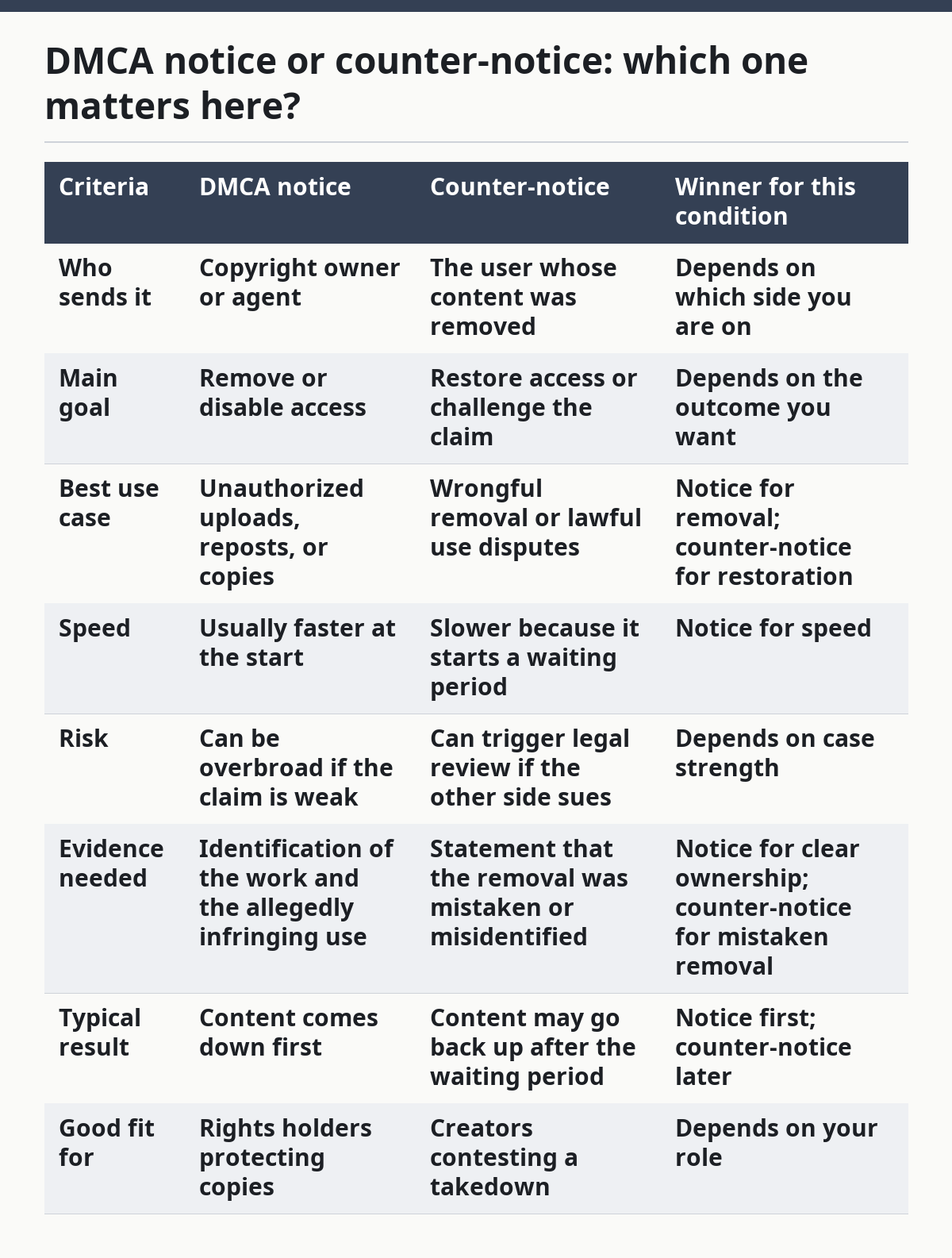
The table is blunt on purpose: the better choice depends on what happened to the content, not on which side sounds more confident. A notice is not “better” than a counter-notice. It is the first move for one side and the wrong move for the other. For background on how online services handle notices, see the Copyright Office’s DMCA page and, for platform policy examples, YouTube copyright help or Meta IP reporting.
When should you ignore a DMCA notice?
You should not ignore a DMCA notice if it affects content, money, or account status. A better move is to read it line by line, check whether it identifies the work and the disputed material, and decide whether the claim is valid, mistaken, or too broad.
A weak notice still has consequences. Platforms often remove first because they are trying to preserve safe-harbor protection under Section 512. If the notice is defective, you may still need to answer it through the platform’s process rather than assuming it will disappear on its own.
The exceptions are narrow. If a notice is clearly spam, not tied to your account, or sent to the wrong place, the practical issue may be minor. Even then, a creator who relies on that content should keep the message, the date, and the file location, because the record can matter later.
What should creators do first?
Creators should first save the notice, identify the exact file or post, and check whether the complaint targets a full work or only part of one. That first review often tells you whether this is a mistaken match, a licensing problem, or a real infringement issue.
The numbers matter here because platform deadlines move fast. A response window can close in days, not months, and the later you wait, the less room you have to fix a bad notice. If the complaint involves a monetized channel, a brand account, or a business archive, the stakes are higher than a single deleted post. For practical examples of notice handling and repeat-infringer policies, see the Copyright Office materials and Google’s copyright policy overview.
If the work is original, licensed, public domain, or protected by fair use, that changes the response. The hard part is that those categories are legal questions, not vibes. If money, launch timing, or a legal threat is involved, speak with a qualified lawyer before sending a counter-notice.
What are the hardest edge cases?
The hardest cases are partial copies, remix content, and mixed-ownership files. Those cases do not fit cleanly into “infringing” or “not infringing,” and that is where people make the most expensive mistakes.
Here are the cases that flip the usual answer:
- A clip includes both copyrighted music and original speech. The notice may be right about one part and wrong about the other.
- A file was uploaded by a contractor or team member. Ownership and permission may depend on the contract, not just the upload history.
- The work is licensed but the license has limits. A 2024 or 2025 license is not the same as perpetual permission.
- The platform uses automated matching. A machine can flag a file that a person would never call infringing.
These cases deserve caution because the wrong reply can lock in the wrong record. The safer position is not “fight every notice.” The better approach is to match the response to the evidence and, when the facts are unclear, get professional advice before filing anything.
What is the honest bottom line?
Choose a DMCA notice if you own the rights and want removal of a specific unauthorized copy. Choose a counter-notice if your content was removed and you have a real basis to say the takedown was mistaken, overbroad, or misidentified. Neither is the right move if the dispute is really about ownership, contract terms, or a possible lawsuit.
That is the cleanest answer because it keeps the decision tied to the facts. A notice starts the removal process; a counter-notice challenges it. If you are unsure which side you are on, that uncertainty is itself a signal to slow down and get advice before you file anything. Related guidance from the Copyright Office and Copyright Alliance fair-use basics can help frame the issue before you respond.
What if I just want my post back?
If you just want your post back, the counter-notice is the path people usually mean. It is the formal response that tells the service provider the removal may have been a mistake, and it can start the restore process after the waiting period.
The catch is that “I want it back” is not enough by itself. A counter-notice usually needs a serious claim that the material was removed in error or misidentification. If the complaint is accurate, sending a counter-notice can create more trouble than it solves.
FAQ
Is DMCAP the same thing as DMCA?
Usually, yes in search intent, but not as a legal term. Most people typing DMCAP are really asking about DMCA notices, takedowns, or counter-notices. The legal framework is the Digital Millennium Copyright Act and Section 512 of the U.S. Copyright Act. For the statute, see 17 U.S.C. §512 and the U.S. Copyright Office DMCA page.
How long does a DMCA takedown take?
A platform can often act quickly, sometimes before the day is over. The counter-notice side has a waiting period that is often described in the 10-to-14 business-day range, depending on the process and whether the complaining party files suit. If time matters, read the notice as soon as it arrives.
Can I just delete the file and be done?
Sometimes, but not always. Deleting the file may stop the immediate problem, yet it does not always fix account strikes, cached copies, or the record of the complaint. If the issue affects your business or portfolio, keep copies of every message and timestamp.
Should I send a counter-notice if I am not sure?
No, not until you understand the risk. A counter-notice is a formal legal response, not a casual reply, and it can move the dispute into a more serious phase. If the facts are unclear, a lawyer is the safer next step.
Does a DMCA notice prove someone stole content?
No, it proves only that someone made a copyright claim under the DMCA process. The notice may be correct, partly correct, or wrong. That is why the counter-notice exists and why platforms do not treat every complaint as the final word.
Drafted with AI; not yet reviewed by a person.